There are times when the effort of living seems disproportionate to what life offers in return. We revisit relationships that evoke the same wounds, work towards something just beyond our reach, or wake with a weariness that sleep cannot resolve. We wonder whether anything is changing, or whether we are simply repeating variations of the same experience.
Perhaps you recognise something of yourself here: having worked hard to reach a particular point, only to be confronted by something you thought you had left behind. The grief that returns unexpectedly, the relationship that falls apart, the anxiety that resurfaces, or the quiet realisation that the life you have built no longer feels entirely your own.
It is within this uncomfortable territory that Albert Camus' The Myth of Sisyphus, first published in 1942, continues to speak to us. Written against a backdrop of war and political instability, its central questions remain strikingly contemporary. How do we continue living when life does not offer the answers we seek? What sustains us when meaning becomes elusive?
In Greek mythology, Sisyphus is condemned by the gods to push an enormous boulder up a mountain. Each time he approaches the summit, the boulder rolls back down, and he must descend to begin again. There is no completion, no final achievement, no moment at which his labour is rewarded with release.
In Titian's painting Sisyphus (1548–1549) we encounter the physicality of this struggle: the muscular body, the awkward limbs, the surrounding darkness and the enormous weight of the stone. We can almost feel the effort required to take another step. There is something profoundly human in this image: a body carrying more than it might reasonably be expected to bear.
Yet what interests Camus is not simply the punishment of Sisyphus, but his consciousness of it. In particular, Camus draws our attention to the moment when Sisyphus descends the mountain. The boulder has fallen, the task remains unfinished, and there is a brief interval between one struggle and the next. It is here, in this moment of awareness, that Camus locates the possibility of freedom.
Sisyphus knows his circumstances. He can neither deny them nor escape them, but his consciousness allows him to establish a relationship with what has been imposed upon him. His fate may not be of his choosing, yet his response to it is not entirely determined by the gods (Camus, 1955).
I find this particularly relevant to psychological suffering. So much of what we encounter in ourselves originates in experiences we did not choose: the families we were born into, the emotional availability of those who cared for us, the losses we experienced, the cultural conditions that shaped who we were permitted to become.
We inherit circumstances, expectations and sometimes wounds that become woven into our personalities, and we carry them without recognising their weight or how they shape the way we relate to ourselves and others.
Our own boulder may not always be visible.
Freud's exploration of repetition compulsion offers one way of understanding why we unconsciously return to circumstances that evoke familiar suffering (Freud, 1920). We can repeatedly find ourselves in emotionally unavailable relationships, feel compelled to prove our worth through achievement, or feel abandoned despite the presence of people who care for us.
Viewed from outside, these patterns can appear irrational, yet psychologically they often possess an internal coherence. The familiar, even when painful, can feel more manageable than the uncertainty of something new, and we are often seeking, unconsciously, a different ending to an earlier experience.
There is something Sisyphean in this repetition. We exert considerable emotional energy attempting to overcome a difficulty, only to find ourselves encountering it again in another form.
Unlike Sisyphus, however, we are not necessarily condemned to repeat the same task for eternity. Through developing awareness, encountering different relational experiences and engaging with unconscious aspects of ourselves, the struggle can change. The boulder can become lighter, or we can discover that some of what we carry does not belong to us at all.
This is where I find myself both drawn to Camus and wanting to move beyond him.
At the heart of his philosophy is the concept of the absurd. For Camus, the absurd emerges through the encounter between our deeply human longing for meaning, clarity and coherence, and a world that offers no guarantee that these longings will be satisfied.
We want suffering to make sense, love to endure, effort to be rewarded and life to unfold with some semblance of justice. Yet people we love die, relationships end, illness arrives unexpectedly, and events fundamentally challenge our understanding of the world and ourselves.
We are confronted, sometimes quite brutally, by the limitations of our agency.
Irvin Yalom (1980) identifies death, freedom, existential isolation and meaninglessness as fundamental concerns of human existence. These are not difficulties that can simply be resolved through psychological insight. They are dimensions of being human, and much of our emotional life involves negotiating our relationship with them.
Our culture, however, seems increasingly uncomfortable with uncertainty. We are urged to optimise ourselves, discover our purpose, become more resilient and turn adversity into meaning. Even suffering becomes another project for self-improvement.
There is an implicit suggestion that, if we approach life correctly, we might somehow transcend its more difficult realities.
What happens, then, when we cannot? When grief does not give way to gratitude, when trauma does not reveal a higher purpose, or when years of effort have not delivered the life we imagined?
Part of our suffering may arise not only from what we experience, but from the belief that we ought to be experiencing something different.
Viktor Frankl's Man's Search for Meaning offers an interesting counterpoint to Camus. Drawing upon his experiences of the Holocaust, Frankl explores our capacity to discover meaning through relationships, creative engagement and our response to circumstances that cannot be changed (Frankl, 1963).
Where Frankl understands meaning as something we can discover within existence, Camus is more sceptical of the need for any ultimate explanation. For him, life can be lived without resolving the question of its inherent meaning.
There is value in holding these perspectives together. Meaning can sustain us, yet the compulsion to find meaning in everything can become another source of suffering. Some experiences never make sense, and we need not turn every wound into a lesson to justify our continued existence.
Sometimes, what has happened is simply painful, unjust or deeply sad.
In the therapy room, I am interested in what becomes possible when we allow ourselves to acknowledge this without immediately searching for a resolution. Can sadness exist without needing to be transformed? Can anger be heard without being explained away? Can we remain curious about our experience without demanding that it deliver an answer?
Donald Winnicott (1971) understood creativity not simply as an artistic undertaking but as a quality of living through which we experience ourselves as real. A creative relationship with life allows us to participate in existence rather than merely complying with its demands.
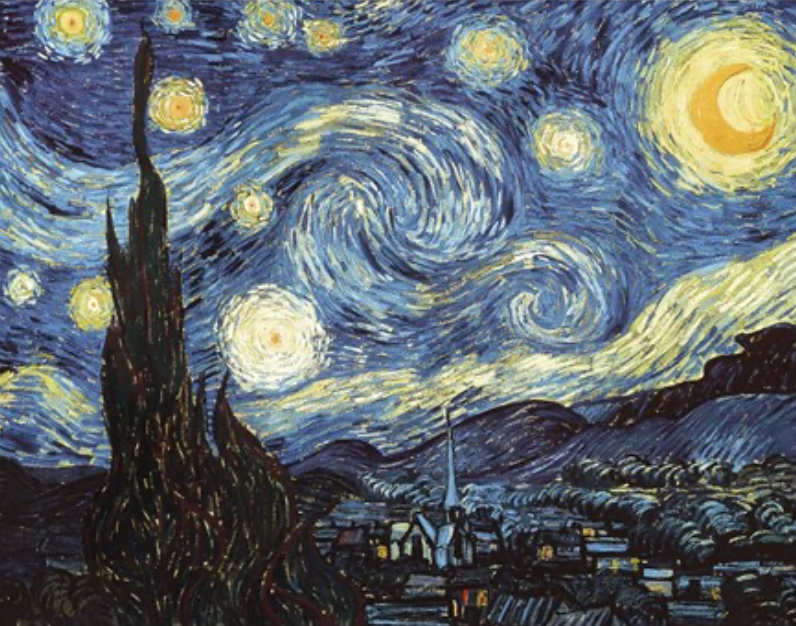
We might think here of the paintings of Vincent van Gogh, particularly The Starry Night (1889). The turbulence of the sky, the relative stillness of the village and the extraordinary movement of colour allow us to encounter something that cannot be adequately communicated through rational explanation. The painting need not reconcile darkness and beauty; it allows them to exist together.
Art offers an encounter with life without requiring us to understand it fully. Music, literature, nature and human intimacy may do the same, returning us to experience itself and reminding us that living is not exclusively an intellectual endeavour.
There is, nevertheless, a more difficult dimension to Camus' work that deserves careful consideration. His essay begins with the question of suicide, asking whether the apparent absence of ultimate meaning makes life unworthy of being lived. His conclusion is a rejection of suicide and an invitation to engage with life.
Yet for someone experiencing profound psychological pain, the distinction between questioning the meaning of existence and feeling unable to continue living is significant.
Someone experiencing suicidal ideation is often struggling with an accumulation of experiences that has overwhelmed their capacity to imagine a different future. Their difficulty may not be philosophical at all, but one of loneliness, shame, trauma, depression, poverty, illness or the absence of relationships in which they feel understood.
To invite someone in such a position to embrace the struggle of Sisyphus without acknowledging their exhaustion could be experienced as another demand upon them.
We need to be careful not to romanticise suffering or confuse perseverance with an obligation to endure intolerable circumstances. People experiencing suicidal distress need compassion, meaningful connection and appropriate clinical support, not simply a philosophical argument for living.
For me, the relational dimension of psychotherapy is especially important here. Sisyphus is alone on his mountain, but our experience of being human need not be quite so solitary.
Martin Buber's (1970) philosophy of the I–Thou relationship invites us to consider how we encounter one another as subjects rather than objects. Something becomes possible through genuine meeting that cannot necessarily be achieved through solitary reflection.
When another person is willing to remain present with our suffering, without withdrawing, judging or immediately attempting to change us, our relationship with that suffering can begin to shift. The circumstances themselves can remain unchanged, yet our experience of carrying them can become different.
Within psychosynthesis, Roberto Assagioli (1973) explores the relationship between awareness, identification and the will. We can begin to recognise that although suffering is part of our experience, it need not constitute the entirety of our identity.
Here, the will does not necessarily mean determination, discipline or the forceful overcoming of difficulty. It can appear in the gentler act of asking for help, allowing ourselves to rest, establishing a boundary or acknowledging that the way we have been living is no longer sustainable.
Camus speaks of revolt as a response to the absurd. I wonder whether, therapeutically, we might understand revolt in similarly modest and deeply personal terms.
Revolt might be the decision to stop organising our lives around others' approval, to grieve something we have spent years denying, to relinquish a relationship, challenge an inherited belief, or recognise the legitimacy of our own needs.
Sometimes perseverance requires us to stop doing what we have always done. There is courage in continuing, but there can be equal courage in changing direction.
Camus famously concludes his essay with the words, ‘One must imagine Sisyphus happy’ (Camus, 1955, Part IV).
I have always found something unsettling in this closing sentiment. Must we imagine him happy? Might we instead imagine him experiencing moments of freedom, tenderness or curiosity, without placing upon him the additional expectation of happiness?
What matters, I think, is not that Sisyphus has reconciled himself entirely to his circumstances, but that his suffering has not extinguished his capacity to experience something beyond it.
The poet Rainer Maria Rilke (1984), in Letters to a Young Poet, invites a more patient relationship with unresolved questions. Rather than insisting on answers, he encourages us to inhabit the questions themselves, allowing understanding to emerge through living.
There is something here, I think, that we can take into our own lives. We do not necessarily need to know where the path leads before we begin to walk it. Meaning can reveal itself gradually, through relationships, ordinary encounters, acts of creativity and the small, often unnoticed ways in which we participate in the world.
And perhaps, at different points in our lives, we need different things from existence: purpose and direction at times, connection at others, and sometimes simply being is enough.
I return to the image of Sisyphus descending the mountain, in the moment between the falling of the boulder and the next ascent, when he is neither pushing nor striving, neither succeeding nor failing.
I wonder how often we allow ourselves such moments.
Maybe it is here, in the space between our struggles, that we become available to ourselves and to one another, recognising that we are more than what we carry and that existence does not need continual justification through effort.
The meaning we have been searching for may not be waiting at the summit after all, but emerging, sometimes almost imperceptibly, through our relationship with the journey itself.
References
Assagioli, R. (1973) The Act of Will. New York: Viking Press.
Buber, M. (1970) I and Thou. Translated by W. Kaufmann. New York: Charles Scribner's Sons. Originally published in 1923.
Camus, A. (1955) The Myth of Sisyphus. Translated by J. O'Brien. London: Hamish Hamilton. Originally published in 1942.
Frankl, V.E. (1963) Man's Search for Meaning: An Introduction to Logotherapy. Boston: Beacon Press.
Freud, S. (1920) Beyond the Pleasure Principle. In: Strachey, J. (ed. and trans.) (1955) The Standard Edition of the Complete Psychological Works of Sigmund Freud, Vol. XVIII. London: Hogarth Press, pp. 7–64.
Rilke, R.M. (1984) Letters to a Young Poet. Translated by S. Mitchell. New York: Random House.
Titian (1548–1549) Sisyphus [Oil on canvas]. Madrid: Museo Nacional del Prado.
Van Gogh, V. (1889) The Starry Night [Oil on canvas]. New York: Museum of Modern Art.
Winnicott, D.W. (1971) Playing and Reality. London: Tavistock Publications.
Yalom, I.D. (1980) Existential Psychotherapy. New York: Basic Books.
Sean Kelly, MBACP — integrative psychotherapist and counsellor working in London W1, Hastings & St Leonards, and online. Registered member of the BACP.